An insider’s view of women’s collegiate icon Jessie Banks
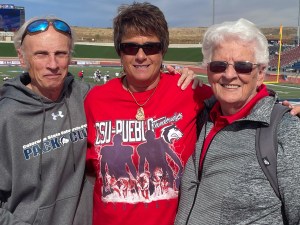
Jessie Banks (right) with Richard Reeder (left) and CSU Pueblo Athletics Hall of Famer Ann deBoe at a Pack football game at the ThunderBowl. The photo was taken in 2020 when deBoe was inducted into the school’s hall of fame.
With the passing last Friday of Centennial State women’s collegiate sports icon Jessie Banks, a former assistant of her penned his thoughts on the late Southern Colorado State College and University of Southern Colorado coach and professor.
Richard Reeder, who worked professionally in Grand Junction, Montrose, Española, N. M., and Cody, Wyo., is now living in St. George, Utah, where he is employed by Walmart.
In his email with the Colorado Collegiate Chronicle, Reeder said he “found comfort in having the mother-son type of conversations with her. When she introduced me to new people, I was meeting them for the first time as the son she never had. I took great pride in that and would tell people she was my second mom.”
Here are Reeder’s words about his “second mom”.
“I met Jessie Banks in the Spring of 1980 when I had to start taking classes with her as a physical education major. She was already known for starting the women’s sports teams at Southern Colorado State College.
“In 1982, I attended a Women’s Basketball Coaches Association coaching clinic and learned firsthand about her career. Every coach from across the country knew Jessie. She was part of the group that created the Association for Intercollegiate Athletics for Women. It was the organization that governed women’s sports nationwide before the NCAA and NAIA stepped in. Every coach I talked to praised Jessie for her dedication to creating opportunities for women to participate in sports.
“She worked with the legendary Harry Simmons, the SCSC Athletic Director who hired her in 1966, to grow those opportunities. They clashed at times, but their mutual respect kept the programs growing.
“The budgets for women’s sports in the beginning were very small. There were no scholarships, and travel expenses were minimal. Jessie often paid for the teams’ travel herself and drove to games in her car, and sometimes in a player’s car. They didn’t stay overnight anywhere because they didn’t have any money for hotels.
“By the late 1970s and into the 1980s, more money was being spent on women’s athletics. The school was part of the Rocky Mountain Athletic Conference and NAIA, and the popularity was growing. Jessie was still working nationally to promote the sports. She sat on many NAIA committees and was the group’s representative to the U.S. National Olympic Committee.
“I began my coaching journey in the fall of 1981. Simmons had been replaced by longtime assistant coach Don McIntosh. McIntosh hired me as a student assistant coach. At the same time, Jessie had stepped down as the volleyball coach and focused purely on basketball.
“I had collaborated with Jessie on some things during that year for her games against rival schools. Jessie offered me the chance to be her assistant coach. The offer came with one stipulation: I was not to hang out, date, or party with the players. I accepted the offer. She also had me take on the role of assistant coach for the volleyball team.
“In 1982, Bob Mullin was hired as the Athletic Director, and that was the beginning of a tumultuous time for USC athletics. Mullin had the dream of taking the men’s basketball program to the NCAA Division I level. He began diverting funds from other programs to fund that dream. He and Jessie clashed regularly as she tried to keep him from hurting the other programs.
Jessie Banks (second row, far left) and Richard Reeder (second row, far right) with the 1982-1983 USC women’s basketball team.
“I was Jessie’s assistant coach for three seasons (1982-85). The 1984-1985 season was her last. By this point, Mullin had depleted the women’s basketball program. We only had one scholarship, which we committed to local standout Denise Huskin of Florence. The rest of the team consisted of walk-ons. By the halfway point of the season, due to players leaving and injuries, we were down to 6 players. We did not win a game.
“To protect the program, Jessie announced her retirement. She would later admit that she considered filing a Title IX complaint, but decided she didn’t want to put the university through the trauma of an investigation. She decided it was in everyone’s best interests for her to walk away. Her replacement was hired with a full complement of scholarships and did not have to carry a teaching load.
“But the Bob Mullin era ended badly for the university as his spending led to the dropping of the football team and several other programs. Something it would take years to recover from.
“Jessie was a tremendous influence on my life. She took a chance on a mouthy kid who was too competitive for his own good. I had a short fuse that led to me earning 27 technical fouls in our 3 seasons together. But she never restrained me or tried to reel me in. She used her Olympic connections and garnered me an invitation to the Olympic trials for the national team handball squad. I was injured in the trials and failed to make the team.
“After her retirement, I left school, and my life went off the rails. I was living a life much different and kept much of it from Jessie, just like I did from my own mom. I lost my mom in 1990, and Jessie stepped into that role. She was there when I finally earned my college diploma in 1992.
“People ask why she was so important to me. The answer is simple. Like my own mom, she believed I would get my life back on track and do good things. Their faith has been rewarded as I have lived a successful life with a beautiful family. Jessie got to be a part of that, which my own mom missed. Like my mom, she knew how to talk to and calm the monster that lives inside my head and keep me out of trouble. I will miss the ability to call and have those mother-son talks with her.
“Jessie’s legacy runs deep at the university. Every female athlete and coach owes her a debt of gratitude. Her commitment and personal sacrifices paved the way for their success. The Indians and now the Thunderwolves were always her family.”
Tim Simmons is an independent event service consultant specializing in the distribution of media information at sporting events and for groups associated with intercollegiate athletics.