 Sixty years after they first took the floor, the legacy of the 1966-1967 Southern Colorado State College (SCSC) men’s basketball team remains a towering milestone in the athletic history of what is now Colorado State University Pueblo.
Operating in just their fourth season as a four-year institution, the Indians engineered a remarkable 19–6 campaign. Playing out of historic home venues on the Orman Campus – affectionately known as “The Pit” – and the District 60 Gym, head coach Harry Simmons crafted a gritty, resilient contender that punched far above its weight class and rewrote the expectations for a program still in its relative infancy.
Reloading After a Departed Dynasty
 Replicating the success of the 1965–1966 squad was a daunting assignment. That previous edition had finished with a dazzling 96.6-point scoring average, only to suffer a heartbreaking exit in the NAIA District 7 playoffs in Albuquerque. More critically, that high-octane offense was fueled by a veteran senior class accounting for nearly 80 percent of those points.
Gone were explosive Michigan imports Sam Moore (22.0 PPG) and Al Nichols (13.0 PPG), alongside hometown Pueblo prep stars Bob Graham (22.4 PPG), Mike Lynch (6.0 PPG), and Joe Ross (8.0 PPG), plus Colorado Springs standout Bill Pfalmer (5.6 PPG).
Faced with a massive talent drain, Simmons turned to his veteran core for stability. He anchored the new roster around experienced frontcourt mainstays Bob Price (4.3 PPG, 4.0 RPG) and John Smith (13.2 PPG, 14.5 RPG).
A New Core Takes Flight
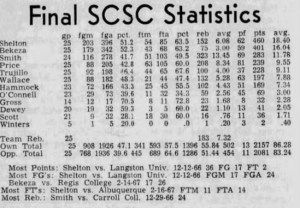 The rebuilding effort clicked faster than anyone anticipated. Price and Smith provided fierce interior presence and rebounding dominance, averaging 9.6 points with 8.3 rebounds, and 11.8 points with 13.5 rebounds, respectively.
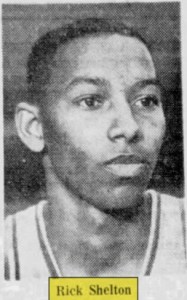
Meanwhile, a potent new scoring punch emerged on the perimeter and wings. Rick Shelton took over as the offensive catalyst with 18.4 points per game, closely followed by Pat Bekeza at 16.0 points per contest. Dan Trujillo became Simmons’ first true point guard, averaging 9.1 points per game.
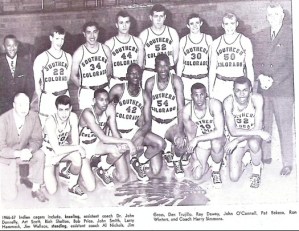
Depth proved to be a vital asset for the Indians. Key reserves Jim Wallace (7.9 PPG) and newcomer Larry Hammock (7.3 PPG) consistently provided a spark off the bench, complemented by John O’Connell, Jim Gross, Ray Dewey, Art Scott, and Ron Winters.
True to the program’s regional identity, nine of the 12 players on the roster hailed directly from the state of Colorado. Bekeza was from Chicago Heights, Ill., and Hammock and Smith were from Muskegon, Mich.
Shelton joined Price, Gross, and Jim Wallace in leading Pueblo Central to a state runner-up spot in 1964 after losing to Denver East in the finals. Winters was from Pueblo South, Dewey from Rye, Scott from Englewood, and O’Connell from Colorado Springs St. Mary’s.
During the 1965-1966 season, Bekeza (8 games), Dewey (3), Shelton (16), Trujillo (12), and Wallace (11) had combined to play 50 games and score 109 points. On the sidelines, Gene “Ball Boy” Rickey and Tim “Fats with the Stats” Simmons were supporting the team with John Donnelly and Al Nichols as assistants.
Out of the Gate Fast
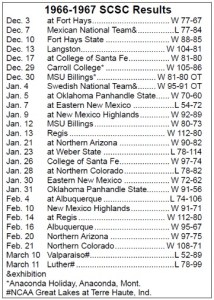
 The newly minted lineup hit the ground running, tearing through the early schedule. SCSC rattled off seven consecutive wins to start the year, building an impressive 11–2 record out of the blocks. Their only missteps during that stretch came in the tough road environments of Eastern New Mexico and Weber State.
Context illuminates the quality of those early losses. Eastern New Mexico – whom the Indians later decisively defeated in a rematch at Pueblo – finished the year at 24-7 (14-1 at home) and advanced to the NAIA national quarterfinals in Kansas City. Weber State, competing proudly in the Big Sky Conference, won 18 games and defended their home court with a 14-2 mark.
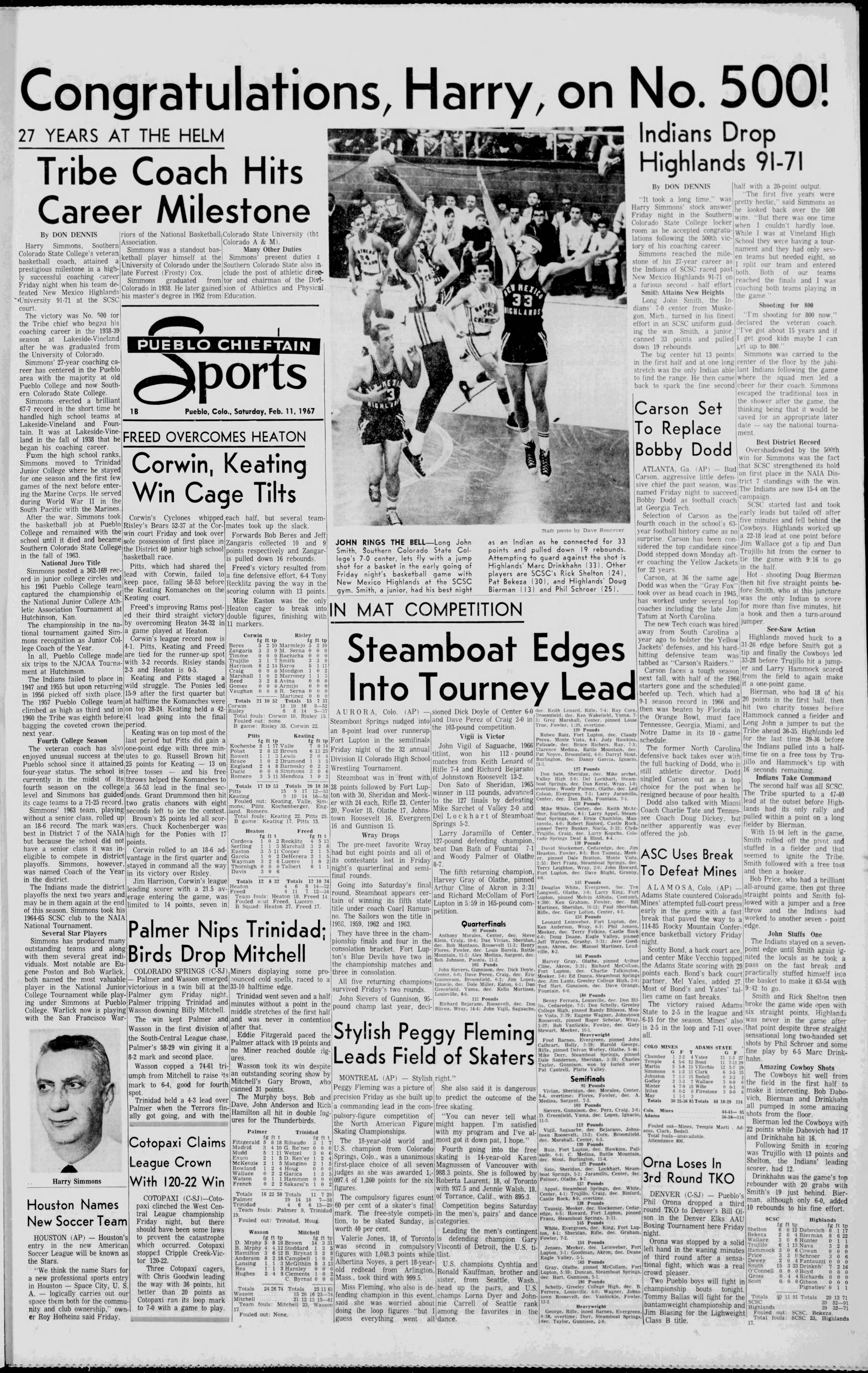
As the season rolled into February, the Indians hit peak stride. They ripped off a five-game winning streak to close the regular season, a stretch highlighted by a 91–71 victory over New Mexico Highlands on February 10. That win marked a monumental milestone: the 500th career coaching victory for the legendary Harry Simmons, a feat celebrated by the campus community with a special reception at the Orman Campus Student Union on February 27.
Breaking Through to the National Stage

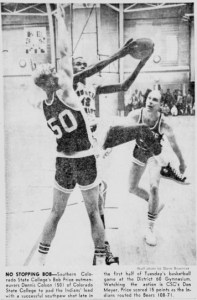 The climax of the regular season arrived on February 21, when SCSC dismantled Northern Colorado 108-71. The win secured more than just bragging rights; it secured the Indians’ bid to the NCAA College Division Great Lakes Regional at Indiana State University in Terre Haute.
It was a satisfying shift in regional power. Northern Colorado had represented the Centennial State in the previous three NCAA College Division Championships. Over their nascent four-year history, SCSC compiled a commanding 6–2 record against their in-state rivals – a sweeter triumph given that the Indians had been ineligible for NCAA postseason play during their first three transition years from a junior college.
Facing the Nation’s Best in Terre Haute
Arriving in Terre Haute for the regional tournament, the Indians ran into a stark reality: a lack of high-level postseason experience against established four-year universities. Compounding the challenge was a grueling 17-day layoff between their final regular-season game and their opening tournament matchup against Valparaiso on March 10.
Simmons had openly worried about the layoff, noting the unique scheduling hurdles faced by an independent four-year school without a conference home. Those fears materialized on the court as SCSC went ice cold. Valparaiso and Luther capitalized, handing the Indians double-digit defeats.
Against Valparaiso, SCSC shot a meager 32.9 percent from the field compared to Valpo’s blistering 50.7 percent. Future Naismith Memorial Basketball Hall of Famer and legendary collegiate coach Gene Bartow observed after the game, “It’s a case of a hot-shooting team catching an opponent who was ice cold.”
Simmons echoed the sentiment, reflecting on what might have been. “With better shooting luck, I think we might very well have been 10 points in the lead at halftime instead of 16 points behind. Had that happened, there’s no telling what might have developed for us later.”
International opponents
SCSC’s second and eighth games of the season did not count, as the host Tribe dropped an 84-77 decision to the Mexican National Team on December 6 and downed the Swedish National Team 95-91 in overtime on January 4. The seven-foot Smith had 40 points and 35 rebounds over two games as he began to be scouted by the professionals. Both countries were touring the United States in preparation for the 1968 Olympic Games in Mexico City.
Despite season-ending setbacks, the 1966-1967 team set the stage
Though the postseason run ended sooner than hoped, history has treated the 1966-1967 SCSC team with the reverence it deserves as the almost same team advanced to the national tournament the next season in Springfield, Mo.
The 1966-1967 Indians proved that Southern Colorado State College was not merely participating in the landscape of four-year collegiate athletics, but immediately rising to compete among the elite. Sixty years later, the grit, talent, and trailblazing spirit of Simmons’ Tribe remain foundational chapters in the rich sporting tradition of CSU Pueblo.