 Long before the ThunderWolves era at Colorado State University Pueblo filled the modern Massari Arena with fans, a distinct maize-and-blue rhythm echoed off the hardwood—all the way from the shores of Lake Michigan.
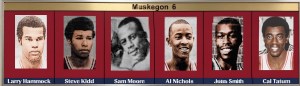
During the formative first decade of Southern Colorado State College’s four-year basketball history, success wore a distinct label: The Muskegon 6.
When SCSC transitioned to a four-year institution in the fall of 1963, it touched off an explosive streak of 10 consecutive winning seasons. Across that span, the Indians compiled a stellar 173-68 record—a commanding 66.8 winning percentage—while playing a brutal schedule that featured nearly 30 percent of their games against current Division I opponents.
At the pulsing heart of that decade-long triumph was an improbable recruiting pipeline stretching from Muskegon, Michigan, straight to Pueblo. Together, six players from the western Michigan city combined for 7,890 points and 4,249 rebounds, capturing three conference titles, reaching seven national tournaments, and etching their names into the bedrock of Colorado collegiate athletics history.
Opening the Pipeline: Nichols, Moore, and Smith
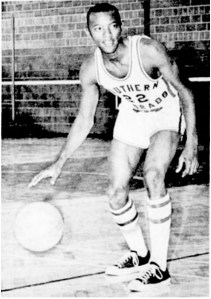
Al Nichols laid the bridge across the Midwest in 1963. A gritty 6-foot point guard, Nichols brought Midwestern poise to the backcourt and was quickly joined by fellow Muskegon native Sam “The Birdman” Moore for SCSC’s historic first varsity season at the four-year level.
That inaugural 1963–1964 squad stunned skeptics by going 18-6, though postseason national tournament bids eluded them due to their first-year status. Moore, however, was just warming up.
The following season, the duo welcomed towering 7-footer John Smith to Pueblo. With Smith anchoring the paint and Moore lighting up scoreboards, the Indians captured the NAIA District No. 7 title and advanced to the national tournament in Kansas City, where they dropped a narrow 66-59 decision to Southwest Louisiana. Moore earned All-American honorable mention honors after averaging 21.2 points per game, eventually finishing his three-year career with 1,589 points in 75 games—a school record at the time. Nichols wrapped up his steady SCSC tenure with 590 points in 76 contests, while Smith quickly established himself as a dominant glass-cleaner, pacing the team with a staggering 14.5 rebounds per game in 1965–1966.
Smith’s dominance continued through the 1966–1967 and 1967–1968 campaigns, guiding the Indians to back-to-back NCAA postseason trips against formidable D-I programs Valparaiso and Missouri State. Pulling down 13.5 and 14.4 rebounds per contest in those respective seasons, Smith completed a legendary 98-game career with 1,243 points and 1,264 rebounds.
Deepening the Roster: Hammock, Kidd, and Tatum

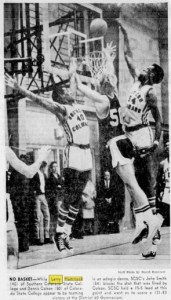
As the 1960s rolled on, the Muskegon influx only deepened the program’s talent pool. Larry Hammock arrived in the fall of 1966, bringing an explosive scoring touch that led the Indians in back-to-back seasons, averaging 18.7 points in 1967–1968 and a blistering 22.3 points per game in 1968–1969.
He was joined in 1968 by Steve Kidd, another foundational cornerstone from Muskegon. Kidd carved out a reputation as one of the program’s fiercest competitors, finishing his career as SCSC’s second-leading all-time rebounder (924) and seventh-leading scorer (1,098). He led the Indians in rebounding for three consecutive seasons during a 61-41 team stretch.
The final piece of the Muskegon puzzle arrived with Cal Tatum for the 1969–1970 season. Tatum delivered an unprecedented four-year scoring reign, leading the Indians in points every single season to finish with 2,143 points (a 20.2 career average) alongside 805 rebounds. Earning third-team All-American honors as a junior, Tatum helped steer SCSC to a 65-40 record, three postseason berths, and two conference titles. His impact was so profound that in 1973, he became the very first SCSC/USC/CSU-P athlete inducted into the Greater Pueblo Sports Hall of Fame.
A Legacy Carved in Stone and Salt
Except for Nichols, every single member of the Muskegon 6 earned well-deserved All-District, All-Conference, and/or All-Regional accolades. Their collective efforts culminated in the golden pinnacle of 1972, when the Indians captured the NCAA Division II West Region title by taking down Cal-Irvine and Seattle Pacific, advancing to the national “Elite Eight” in Evansville, Indiana.
Ten seasons. 173 wins. Three conference championships. And six young men from a city on the edge of Lake Michigan who crossed the country to help build a basketball dynasty under the southern Colorado sun.